
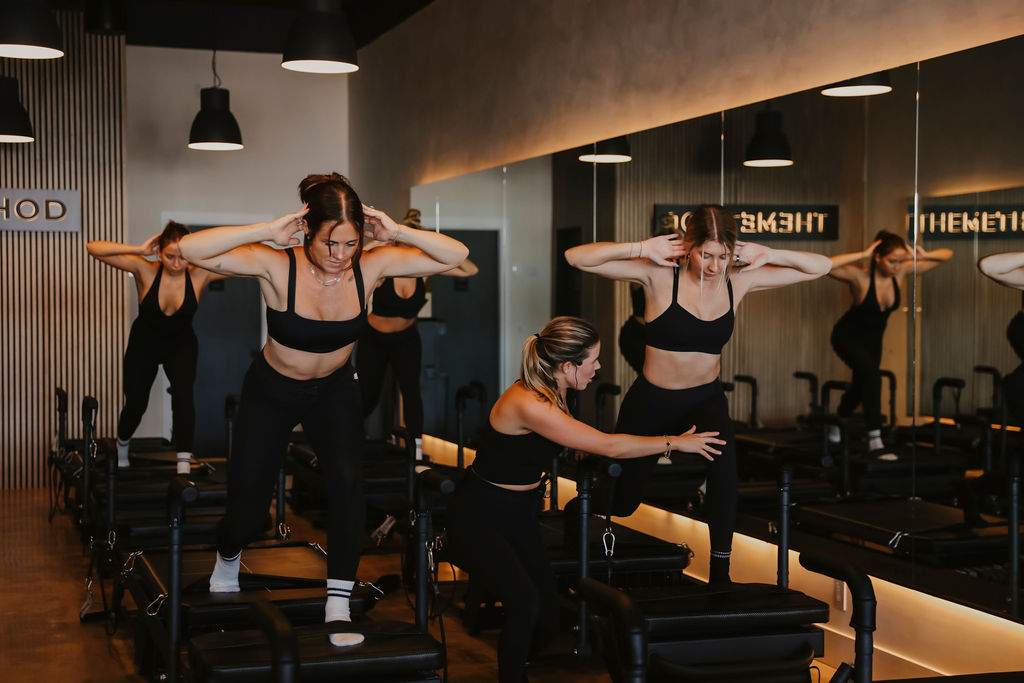
Why Slow Movement Burns More: The Science Behind Time Under Tension
Why Slow Movement Burns More: The Science Behind Time Under Tension
If you’ve ever taken a Pilates class and felt that delicious shake during a slow series, you already know: moving slowly is surprisingly hard. But what you may not know is why those tiny, controlled movements fire up your muscles more than fast, dynamic reps. The answer lies in a powerful training principle called time under tension—and it’s one of the reasons Pilates is so effective for building strength, stability, and endurance.
What is time under tension?
Time under tension (TUT) refers to the amount of time a muscle is actively working during an exercise. Instead of racing through reps, slowing things down keeps your muscles engaged for longer, increasing the training stimulus.
In Pilates, this often looks like:
-
a 10-second roll down,
-
holding a teaser at its toughest point,
-
or resisting the springs all the way back to start position.
These mindful, controlled movements create continuous engagement—which your muscles definitely feel.
Why Slow Movement Burns More
Here’s what’s happening inside your body when you slow things down:
1. More Muscle Fiber Recruitment
When you move slowly, your body can’t rely on momentum to help you. That means the working muscles have to fire continuously, activating more total muscle fibers—especially the smaller stabilizing muscles that often get overlooked in faster workouts.
2. Increased Metabolic Stress
A longer working time means more metabolic by-products (like lactate) build up in the muscle. This is the “burn” you feel—and it’s a key driver of muscle adaptation, toning, and endurance.
3. Better Form = Better Results
Fast movements make it easier to “cheat” with momentum or misalignment. Slow movement forces your brain and body to connect, helping you:
-
maintain proper form,
-
activate the right muscles,
-
and protect your joints.
This mind-body connection is the foundation of Pilates.
4. Enhanced Core Engagement
Pilates emphasizes controlled movement from a strong center. When you slow the tempo, the core has to stabilize your spine through the entire range of motion, leading to deeper, more effective engagement.
How to Apply Time Under Tension in Your Pilates Practice
You don’t have to overhaul your workout—just try these small adjustments:
-
Move intentionally: Count to 4 on the way out and 4 on the way back.
-
Pause at the hardest point: A 2-second hold works wonders.
-
Resist the spring tension: Don’t let the equipment do the work for you.
-
Focus on control, not speed: Quality over quantity—always.
The Result? Stronger, Leaner, More Connected Movement
Slowing down may feel harder, but that’s exactly why it’s so effective. By increasing time under tension, you train smarter—not just harder—and get more out of every rep.
Next time your instructor cues “go slower,” embrace it. Your muscles (and your results) will thank you.